📋 Common Claim Settlement Challenges and How to Avoid Them
Insurance is designed to provide financial support when a loss occurs. However, sometimes policyholders face challenges during the claim settlement process.
Many claim-related problems can be avoided through proper understanding, accurate information, and timely action.
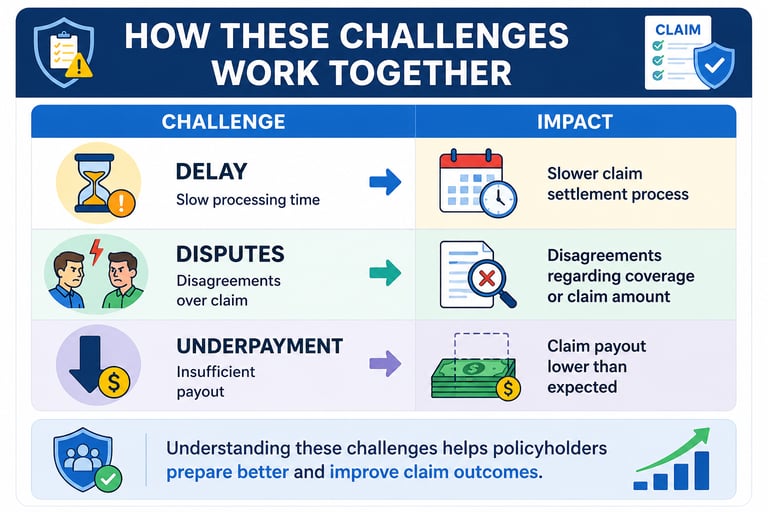
Three common claim settlement challenges are:
Delay
Disputes
Underpayment
Let's understand these challenges and learn how to avoid them.
⏳ Delay – Slow Processing Time
One of the most common complaints during claims is delay in settlement.
Claims may take longer than expected due to:
Incomplete documentation
Missing information
Delayed claim intimation
Investigation requirements
Verification processes
Example
A policyholder submits a health insurance claim but forgets to provide important medical documents.
The insurer requests additional information, causing delays in processing.
How to Avoid Delays
✅ Report claims as soon as possible
✅ Submit complete documentation
✅ Respond quickly to insurer queries
✅ Keep policy information updated
Why It Matters
Timely claim submission and proper documentation can significantly speed up the settlement process.
⚖️ Disputes – Disagreements Over Claims
Claim disputes occur when the policyholder and insurer disagree about coverage, claim amount, or policy conditions.
Common reasons include:
Misunderstanding policy terms
Non-disclosure of important information
Coverage exclusions
Differences in loss assessment
Example
A vehicle owner expects a claim for a type of damage that is specifically excluded under the policy.
This may lead to disagreement during claim settlement.
How to Avoid Disputes
✅ Read policy terms carefully
✅ Understand exclusions and limitations
✅ Disclose all relevant information honestly
✅ Ask questions before purchasing the policy
Why It Matters
Clear understanding of policy coverage reduces the chances of misunderstandings and disputes.
💰 Underpayment – Insufficient Claim Payout
Underpayment occurs when the claim amount received is lower than expected.
This can happen due to:
Deductibles or excess clauses
Underinsurance
Depreciation deductions
Policy limits
Partial coverage conditions
Example
A property worth ₹50 lakh is insured for only ₹25 lakh.
In the event of a major loss, the settlement may be lower because the property was underinsured.
How to Avoid Underpayment
✅ Choose adequate sum insured
✅ Review coverage regularly
✅ Understand deductibles and policy limits
✅ Update policy values when assets increase
Why It Matters
Proper insurance planning helps ensure adequate financial protection when a claim occurs.
🌍 Real-World Example
A factory suffers damage due to a fire.
Delay
Some documents are submitted late, slowing the process.
Dispute
The owner believes certain damaged items are covered, while the policy excludes them.
Underpayment
Part of the property was insured below its actual value.
As a result, the claim settlement becomes more complicated than expected.
Many such issues can be avoided through proper policy understanding and preparation.
👨💼 Why Insurance Advisors Should Understand This
Knowledge of claim challenges helps advisors:
✅ Educate customers effectively
✅ Improve customer satisfaction
✅ Reduce claim-related misunderstandings
✅ Support smoother claim experiences
✅ Build long-term trust
Advisors who prepare customers before a claim often create stronger relationships after a claim.
💬 Advisor Script Suggestion
"Most claim issues can be avoided by providing accurate information, understanding policy coverage, maintaining adequate insurance, and submitting documents on time. Preparation today helps ensure a smoother claim experience tomorrow."
Simple and practical. ✅
🎯 Key Takeaways
Delays often result from incomplete documentation or late reporting.
Disputes usually arise from misunderstandings about policy coverage.
Underpayment may occur due to underinsurance, deductibles, or policy limits.
Proper disclosure and policy understanding reduce claim problems.
Adequate coverage helps avoid financial shortfalls during claims.
Good preparation leads to faster and smoother claim settlement.
Insurance claims are most successful when policyholders understand their coverage and follow the correct procedures. By avoiding common mistakes, customers can improve their chances of a smooth and satisfactory claim settlement experience.