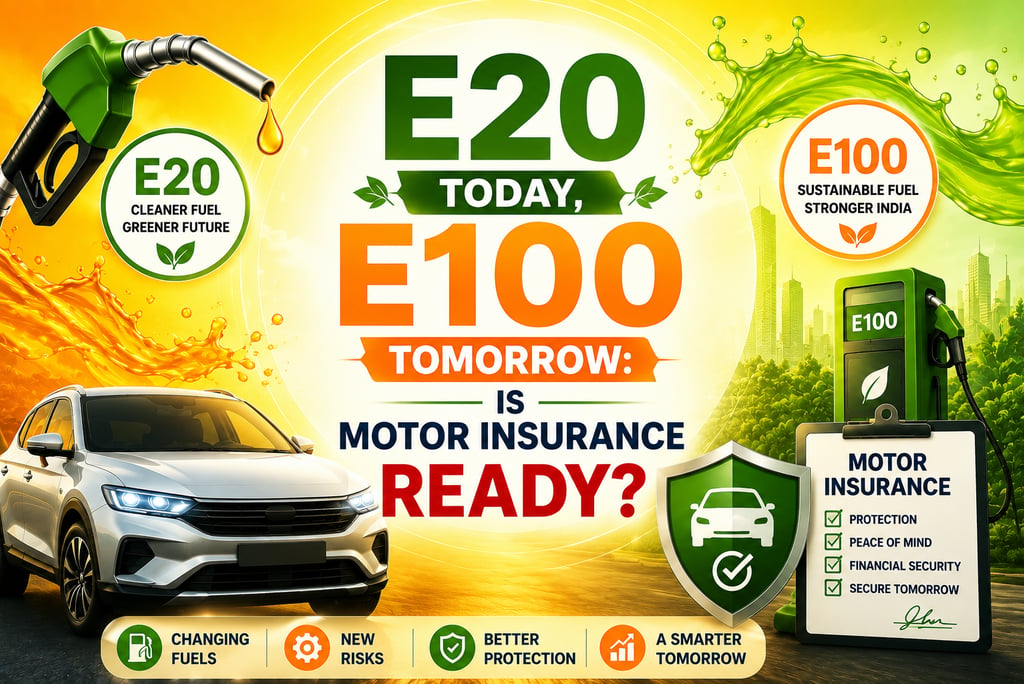
E20 Today, E100 Tomorrow: How Fuel Will Shape the Future of Motor Insurance
India's automotive landscape is undergoing a significant transformation. After successfully introducing E20 petrol (20% ethanol and 80% petrol), the country is now preparing for the next phase of its green fuel journey with E100 ethanol and flex-fuel vehicles. Will motor insurance evolve to protect vehicles running on higher ethanol blends? Let's find out.
MOTOR INSURANCEGENERAL
Robin
6/29/20263 min read
Understanding E20 and E100 Fuel
E20 is a blend containing 20% ethanol and 80% petrol. It has now become the standard petrol available across most parts of India.
E100, on the other hand, is nearly pure ethanol and can only be used in specially designed flex-fuel vehicles equipped with ethanol-compatible engines and fuel systems.
The Government of India is promoting ethanol-blended fuels to:
Reduce crude oil imports
Improve energy security
Support farmers and the biofuel industry
Reduce greenhouse gas emissions
Promote sustainable transportation
While these benefits are significant, the transition also introduces new risks that motor insurers must understand.
Why Ethanol Fuel Changes the Insurance Landscape
Traditional petrol and diesel vehicles were designed around conventional fuels. Ethanol behaves differently.
It is:
More corrosive to certain materials
Highly absorbent to moisture
A stronger cleaning solvent
Different in combustion characteristics
Vehicles designed for E20 or E100 include upgraded components that can withstand these properties. Older vehicles may not.
This difference directly impacts maintenance, repairs, and ultimately, insurance claims.
Impact on Older Vehicles
Many vehicles manufactured before widespread E20 compatibility may experience gradual deterioration of:
Rubber fuel hoses
Fuel seals
Plastic connectors
Fuel pumps
Fuel injectors
Metal fuel tanks
Ethanol can absorb moisture from the atmosphere, increasing the possibility of corrosion if fuel remains unused for extended periods.
Although these issues usually develop gradually rather than suddenly, repair costs can be substantial.
Will Motor Insurance Cover Ethanol-Related Damage?
This is where many vehicle owners are surprised.
A standard comprehensive motor insurance policy generally covers:
Accidental damage
Fire
Theft
Natural calamities
Third-party liability
However, it usually excludes:
Mechanical breakdown
Wear and tear
Corrosion
Gradual deterioration
Lack of maintenance
If engine components fail due to prolonged exposure to ethanol in an incompatible vehicle, insurers may classify the damage as mechanical wear rather than an insured accident.
Consequently, the repair costs may have to be borne by the vehicle owner.
Does Engine Protect Add-on Provide Coverage?
Engine Protect Add-ons are designed to cover certain engine-related losses that are otherwise excluded under a standard motor policy.
These may include:
Water ingress during floods
Hydrostatic lock
Engine seizure due to lubricating oil leakage
Certain accidental internal engine damages
However, ethanol-related corrosion presents a different situation.
Since E20 is the approved fuel supplied in India, insurers may consider gradual fuel-system deterioration as a maintenance issue rather than accidental damage.
Policy terms differ between insurers, making it essential for customers to carefully review the coverage and exclusions before purchasing an Engine Protect Add-on.
How Motor Insurance May Evolve
As India gradually transitions towards E100 and flex-fuel vehicles, motor insurance products are also expected to evolve.
Future policies may include:
Ethanol Fuel System Protection
Specialised coverage for ethanol-compatible fuel systems and related components.
Enhanced Engine Protection
Expanded protection for fuel-system damage resulting from approved ethanol blends, subject to policy conditions.
Vehicle Compatibility-Based Pricing
Premiums may eventually consider:
Vehicle age
Fuel compatibility
Engine technology
Manufacturer specifications
Preventive Maintenance Incentives
Insurers could encourage periodic inspections and preventive servicing by offering premium benefits.
Manufacturer Partnerships
Insurance companies may collaborate with automobile manufacturers and authorised service centres to improve claim settlement and repair quality.
The Future of India's Automobile Industry
The move towards higher ethanol blends will influence every segment of the automobile ecosystem.
Vehicle Manufacturers
Manufacturers are investing in:
Flex-fuel technology
Ethanol-resistant components
Advanced engine management systems
Improved fuel efficiency
Service Industry
Repair workshops will require:
New diagnostic equipment
Technician training
Specialised spare parts
Updated servicing procedures
Insurance Industry
Motor insurance will increasingly focus on:
Technology-based underwriting
Specialised engine protection
Component-specific coverage
Preventive risk management
Usage-based insurance solutions
What Vehicle Owners Should Do
To minimise future risks:
Check whether your vehicle is E20-compatible.
Follow the manufacturer's fuel recommendations.
Avoid storing ethanol fuel in the tank for long periods if the vehicle is rarely used.
Replace ageing fuel hoses and seals where recommended.
Read your insurance policy carefully, especially exclusions relating to engine damage.
Consider suitable add-on covers after understanding their scope and limitations.
Preventive maintenance remains the most effective way to avoid costly repairs.
What This Means for Insurance Professionals
For insurance advisors and intermediaries, the transition to ethanol-blended fuels presents a valuable opportunity.
Customers will increasingly seek guidance on:
Fuel compatibility
Engine Protect Add-ons
Policy exclusions
Vehicle maintenance
Future insurance requirements
Professionals who understand these evolving risks will be better positioned to provide meaningful advice and build long-term customer trust.
Key Takeaway
India's transition from E20 today to E100 tomorrow represents much more than a fuel change.
It marks a significant shift in vehicle technology, maintenance practices, risk assessment, and motor insurance.
As engines become more sophisticated and fuels continue to evolve, motor insurance products must also adapt to provide relevant protection for modern vehicles.
For vehicle owners, understanding these changes is essential. For insurers and insurance professionals, it is an opportunity to develop innovative products and educate customers about the future of automobile insurance.
The future of mobility is changing—and the future of motor insurance is changing with it.