⚖️ Lessons from Real Insurance Disputes
Insurance is designed to provide financial protection when unexpected events occur. However, not every claim is settled smoothly. Sometimes disagreements arise between policyholders and insurers regarding coverage, claim amounts, or policy conditions.
Real insurance disputes provide valuable lessons for policyholders, advisors, and insurers alike.
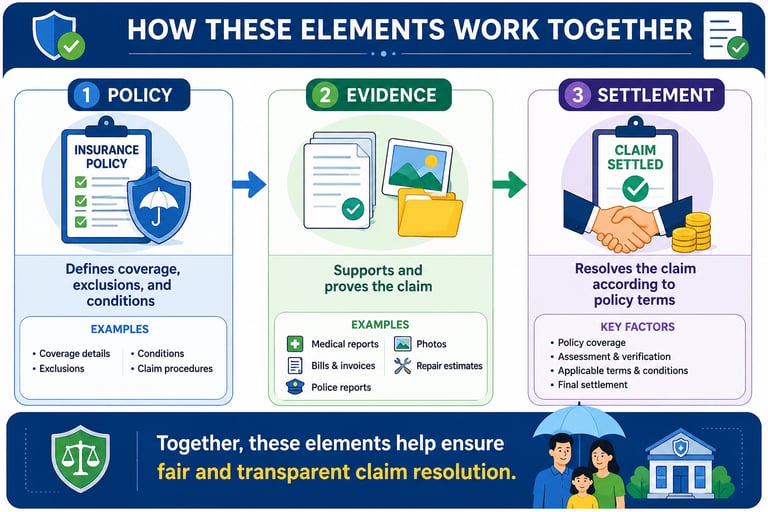
Most disputes revolve around three key areas:
Policy
Evidence
Settlement
Understanding these areas can help prevent misunderstandings and improve claim outcomes.
📄 Policy – Understanding the Terms of the Contract
Every insurance policy is a legal contract that clearly defines:
What is covered
What is excluded
Policy conditions
Claim procedures
Rights and responsibilities
Many disputes occur because policyholders are unaware of specific terms or exclusions.
Example
A property owner files a claim for damage caused by an event that is specifically excluded under the policy.
The insurer rejects the claim based on the policy wording, leading to a dispute.
Lesson Learned
Always read and understand:
✅ Coverage details
✅ Exclusions
✅ Waiting periods
✅ Deductibles
✅ Policy conditions
A clear understanding of the policy helps avoid surprises during claims.
🔍 Evidence – Proving the Facts
Insurance claims are based on facts and supporting documentation.
The insurer requires evidence to verify:
The loss occurred
The cause of the loss
The extent of the damage
Eligibility for coverage
Examples of Evidence
Medical reports
Hospital bills
Police reports
Repair estimates
Photographs
Purchase invoices
Example
A vehicle owner reports accident damage but is unable to provide sufficient evidence regarding the incident.
This may delay the claim or create disagreements during assessment.
Lesson Learned
Keep proper records and documentation.
Strong evidence often leads to faster and smoother claim settlement.
🤝 Settlement – Reaching a Fair Resolution
Settlement is the final stage of the claim process.
The insurer reviews:
Policy coverage
Evidence submitted
Surveyor reports
Applicable conditions
The claim is then settled according to policy terms.
Example
A fire damages a business premises.
After reviewing documents and conducting an assessment, the insurer determines the admissible claim amount and settles the loss accordingly.
Lesson Learned
Fair settlements depend on:
Accurate disclosure
Proper documentation
Clear communication
Understanding policy conditions
🌍 Real-World Example
Consider a homeowner who files a claim after storm damage.
Policy
The insurer reviews whether storm damage is covered.
Evidence
The homeowner provides photographs, repair estimates, and supporting documents.
Settlement
The insurer assesses the loss and determines the payable amount according to policy terms.
When any of these elements are weak or misunderstood, disputes can arise.
🔗 How These Elements Work Together
👨💼 Why Insurance Advisors Should Understand This
Understanding common dispute causes helps advisors:
✅ Educate customers effectively
✅ Improve policy understanding
✅ Encourage proper documentation
✅ Reduce claim-related conflicts
✅ Build trust and credibility
Well-informed customers are less likely to face avoidable claim disputes.
💬 Advisor Script Suggestion
"Most insurance disputes can be avoided by understanding the policy, maintaining proper records, and providing complete evidence when filing a claim. Preparation and transparency help ensure smoother claim settlement."
Simple and practical. ✅
🎯 Key Takeaways
Most insurance disputes involve policy interpretation, evidence, or settlement issues.
Policy terms determine what is covered and what is excluded.
Strong evidence supports successful claim settlement.
Fair settlements depend on accurate information and documentation.
Understanding policy conditions helps reduce misunderstandings.
Good preparation improves claim outcomes and customer satisfaction.
Insurance disputes often provide valuable lessons. By understanding policy terms, maintaining proper evidence, and communicating clearly during claims, policyholders can improve their chances of a fair and timely settlement.