💬 Overcoming Common Client Objections to Insurance
Every insurance advisor encounters clients who hesitate before purchasing a policy. These concerns are natural and often arise because clients do not fully understand insurance or are unsure about its value.
Successful advisors do not argue with clients. Instead, they listen carefully, understand the concern, and provide a clear and helpful response.
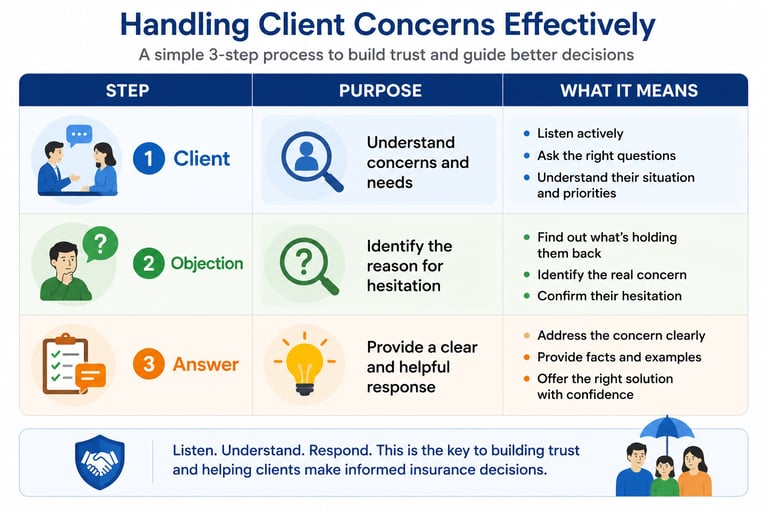
The process is simple:
Understand the Client
Identify the Objection
Provide the Right Answer
This approach builds trust and helps clients make informed decisions.
👤 Step 1: Understand the Client
Before addressing any objection, advisors should understand the client's situation and concerns.
Every objection has a reason behind it.
Sometimes clients may be worried about:
Affordability
Lack of understanding
Previous bad experiences
Trust issues
Competing financial priorities
Listening first helps advisors respond more effectively.
Example
A client says:
"I don't think I need insurance right now."
Instead of immediately explaining policy features, ask:
"What makes you feel that way?"
This opens the conversation and helps identify the real concern.
❓ Step 2: Identify the Objection
Once the client shares their concern, identify the specific objection.
Some of the most common insurance objections include:
"Insurance is too expensive."
Clients often focus on the premium rather than the protection provided.
"I already have enough insurance."
Many people believe employer coverage or existing policies are sufficient when they may not be.
"Nothing will happen to me."
Clients sometimes underestimate risks because they have never experienced a major loss.
"I need more time to think."
This may indicate uncertainty, lack of understanding, or the need for additional information.
"I've never made a claim."
Some clients feel premiums are wasted if they have not used the policy.
Understanding the real objection is the key to providing the right response.
🎯 Step 3: Provide a Clear and Helpful Answer
Once the concern is identified, respond with facts, examples, and empathy.
The goal is to educate, not pressure.
Objection: "Insurance is too expensive."
Response
"Insurance helps protect you from expenses that could be much larger than the premium. A small monthly cost today can help prevent a major financial burden in the future."
Objection: "I already have coverage."
Response
"That's great. Let's review your current coverage together and see whether it fully meets your family's needs and future goals."
Objection: "Nothing will happen to me."
Response
"Most people hope they never face an accident, illness, or unexpected loss. Insurance is designed to protect you if something unexpected does happen."
Objection: "I need more time."
Response
"I understand. Are there any specific questions or concerns I can help clarify so you can make an informed decision?"
Objection: "I've never claimed."
Response
"That's actually good news. Insurance is there to provide protection when needed, much like a seatbelt that you hope never has to protect you."
🌍 Real-Life Example
Client Concern
A 35-year-old professional says:
"I am healthy, so I don't think I need health insurance."
Objection
The client believes good health eliminates risk.
Advisor Response
"Being healthy today is a positive thing. However, medical emergencies can happen unexpectedly. Health insurance helps protect your savings if a major hospitalization occurs in the future."
This response focuses on education rather than fear.
🔗 How the Process Works Together
👨💼 Why Advisors Should Master Objection Handling
Effective objection handling helps advisors:
✅ Build trust and credibility
✅ Improve communication skills
✅ Better understand client needs
✅ Increase customer confidence
✅ Support informed decision-making
Remember, objections are not necessarily rejections. Often, they are simply requests for more information.
💬 Advisor Script Suggestion
"I understand your concern. Many people have the same question. Let's look at how this coverage can help protect you and your family from unexpected financial challenges."
Simple, respectful, and professional. ✅
🎯 Key Takeaways
Client objections are a normal part of the insurance process.
Listen carefully before responding.
Identify the real reason behind the hesitation.
Use clear explanations and real-life examples.
Focus on education rather than persuasion.
Good objection handling builds trust and confidence.
The best insurance advisors are not those who talk the most—they are the ones who listen carefully, understand client concerns, and provide thoughtful solutions. When objections are handled professionally, they become opportunities to build stronger client relationships.