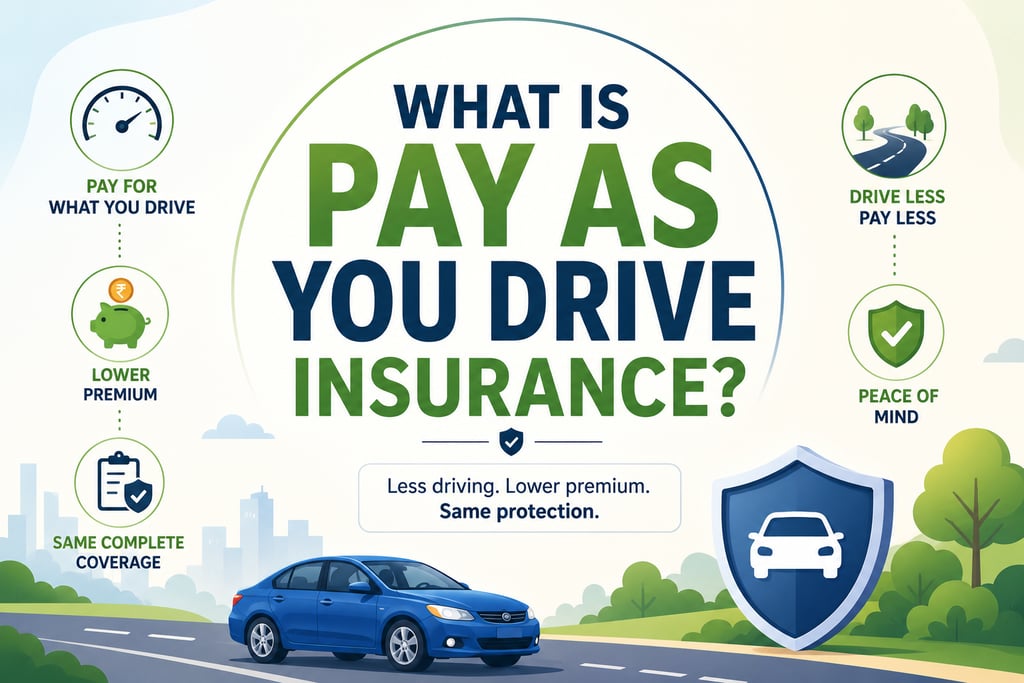
What is Pay As You Drive Insurance?
Most car insurance policies assume that a vehicle is driven regularly throughout the year. But what if you rarely use your car? Perhaps you work from home, use public transport, own a second car, or only drive on weekends. Why should you pay the same premium as someone who drives every day? This is where Pay As You Drive (PAYD) Insurance comes into the picture.
MOTOR INSURANCE
Robin
6/23/20262 min read
🚗 Pay As You Drive Insurance: A Smart Option for Low-Mileage Car Owners
Pay As You Drive (PAYD) is a motor insurance option where the premium is linked to the number of kilometres driven.
Instead of paying a standard Own Damage (OD) premium based on average vehicle usage, customers choose a mileage slab that matches their expected annual driving.
Simply put: Less driving = Lower risk = Lower premium
How Does PAYD Insurance Work?
At the time of policy purchase or renewal, the policyholder:
Declares the vehicle's current odometer reading.
Selects an annual kilometre limit.
Receives a discounted Own Damage premium based on the chosen slab.
Common kilometre slabs include:
2,500 km
5,000 km
7,500 km
10,000 km
The lower the declared usage, the higher the potential discount.
What Coverage Does It Provide?
PAYD policies generally provide protection similar to a standard comprehensive motor policy.
Coverage may include:
✅ Accidental damage
✅ Theft
✅ Fire damage
✅ Natural calamities
✅ Man-made perils
✅ Third-party liability (mandatory under law)
The main difference is that the Own Damage premium is linked to vehicle usage.
Who Should Consider PAYD Insurance?
PAYD is ideal for:
Work From Home Professionals
People who no longer commute daily.
Senior Citizens
Vehicle usage may be limited to occasional trips.
Second Car Owners
Cars used only during weekends or family outings.
Low-Mileage Drivers
Anyone driving significantly less than the average motorist.
Benefits of PAYD Insurance
💰 Lower Premiums
Low-mileage drivers can enjoy significant savings on the Own Damage portion of the premium.
🚘 Fair Pricing
Customers pay based on actual vehicle usage rather than estimated usage.
📈 Encourages Responsible Usage
The concept aligns premium with risk exposure.
🔄 Flexible Options
Many insurers offer kilometre top-ups if usage exceeds the selected slab.
Things Customers Should Know
Before opting for PAYD, customers should understand a few important points.
Odometer Verification
Insurers may verify odometer readings during policy issuance or renewal.
Exceeding the Kilometre Limit
If actual usage exceeds the selected slab:
Additional kilometre packs may be required.
Premium adjustments may apply.
Policy conditions should be reviewed carefully.
Accurate Declarations Matter
Incorrect odometer readings can create complications during claims.
Honesty remains essential.
What This Means for Insurance Advisors
PAYD represents a growing trend toward personalized motor insurance.
Instead of offering the same solution to every customer, advisors can recommend coverage based on actual usage patterns.
Customers increasingly expect:
Fair pricing
Flexible products
Customized insurance solutions
PAYD helps address all three.
InsuranceWallet's Perspective
Pay As You Drive Insurance is not suitable for everyone.
Daily commuters and high-mileage drivers may not benefit significantly.
However, for customers who drive less than average, PAYD can be an excellent way to reduce insurance costs without compromising protection.
As the insurance industry moves toward customer-centric and usage-based products, PAYD is likely to become an increasingly important option for private car owners.
🎯 Key Takeaways
✔ PAYD links premium to annual vehicle usage.
✔ Ideal for low-mileage private car owners.
✔ Offers potential savings on Own Damage premium.
✔ Coverage remains similar to standard motor insurance.
✔ Accurate odometer declaration is essential.
✔ A useful option for work-from-home users, senior citizens, and second-car owners.
Final Thought
The future of motor insurance is moving towards personalization.
Instead of paying for coverage based on assumptions, PAYD allows customers to pay based on how they actually use their vehicles — making insurance fairer, smarter, and more customer-friendly.